- Date: 2025 september
Abstract
Background:
Vitiligo is a chronic depigmenting disorder whose management remains challenging. Although oxidative stress is recognized as one of the key mechanisms involved in vitiligo pathogenesis, the therapeutic role of antioxidant supplementation remains insufficiently substantiated by clinical evidence. Gliadin-protected superoxide dismutase (GP-SOD) is an orally administered antioxidant formulation designed to enhance the stability and bioavailability of superoxide dismutase. This study aimed to evaluate the efficacy and safety of GP-SOD used in combination with narrowband ultraviolet B (NB-UVB) phototherapy in patients with non-segmental vitiligo.
Methods:
This was a 24-week prospective monocentric study conducted in the Department of Dermatology at Farhat Hached Hospital, Sousse, Tunisia. Seventeen adult patients with non-segmental vitiligo affecting more than 5% of total body surface area were enrolled.
Patients received oral GP-SOD at a dose of 1 g/day for the first 12 weeks, followed by 500 mg/day for an additional 12 weeks, in combination with twice-weekly NB-UVB phototherapy throughout the study period. The primary endpoints were changes in Vitiligo Extent Score (VES) at Week 12 and Week 24, as well as the proportion of patients achieving at least 30% (VES30) and 50% (VES50) improvement.
Results:
The study population included 12 women and 5 men, with a mean age of 42 years (range: 16–65 years). The mean duration of vitiligo was 7.65 years. Phototype IV was the most frequently represented skin phototype (65%).
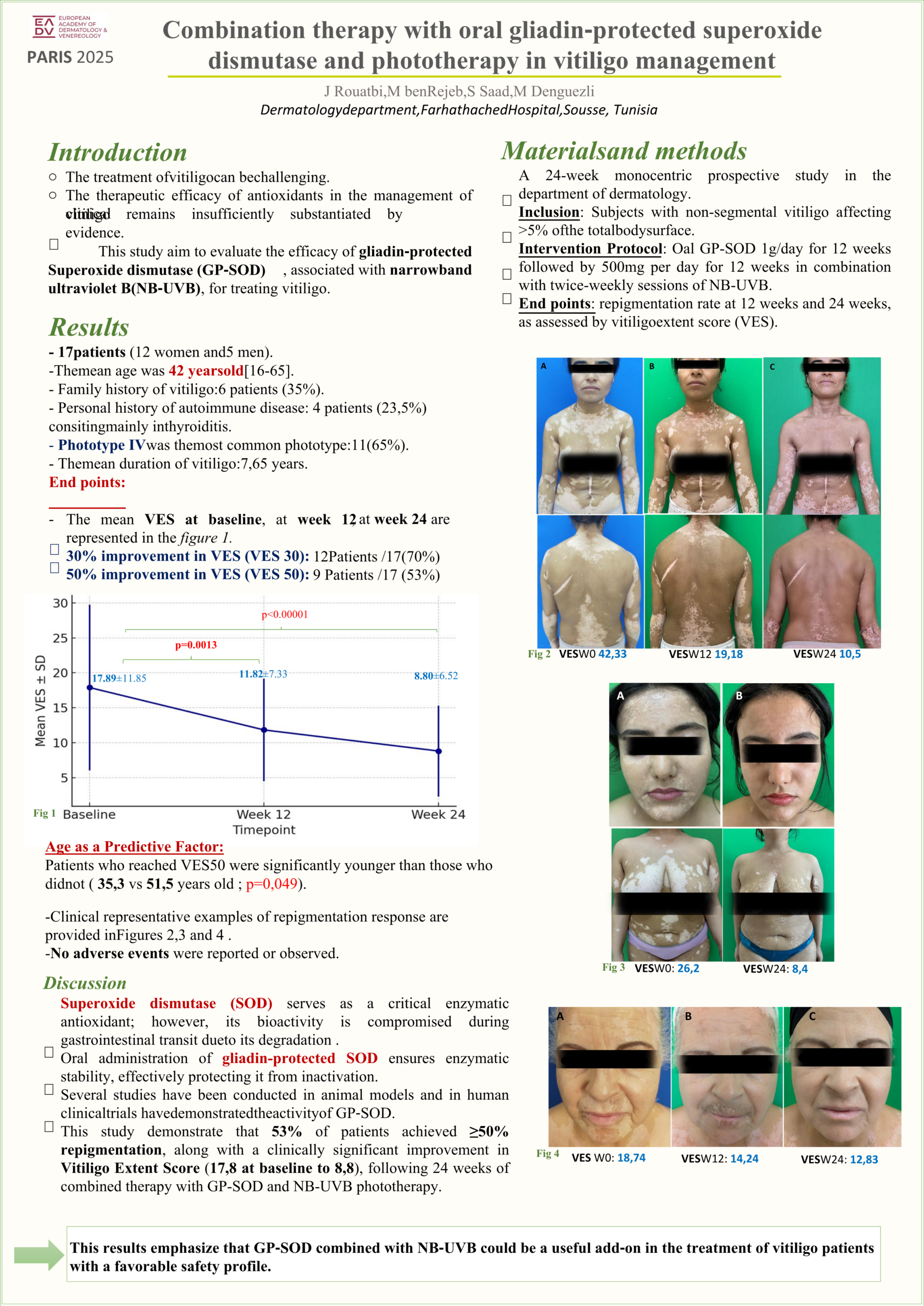
Mean VES significantly improved over the course of treatment, decreasing from 17.89 ± 11.85 at baseline to 11.82 ± 7.33 at Week 12 (p = 0.0013) and to 8.80 ± 6.52 at Week 24 (p < 0.0001 versus baseline).
At Week 24, 12 of 17 patients (70%) achieved at least a 30% improvement in VES (VES30), while 9 of 17 patients (53%) achieved at least a 50% improvement (VES50). Patients achieving VES50 were significantly younger than non-responders (35.3 vs 51.5 years, p = 0.049).
Representative clinical cases demonstrated substantial repigmentation after 24 weeks of combined treatment. No adverse events were reported during the study period.
Conclusions:
In this prospective study, oral gliadin-protected superoxide dismutase combined with NB-UVB phototherapy was associated with significant improvements in disease extent in patients with non-segmental vitiligo and showed a favorable safety profile. These findings suggest that GP-SOD may represent a useful adjunctive approach to NB-UVB phototherapy in the management of vitiligo. Larger controlled studies are warranted to further confirm these preliminary results.